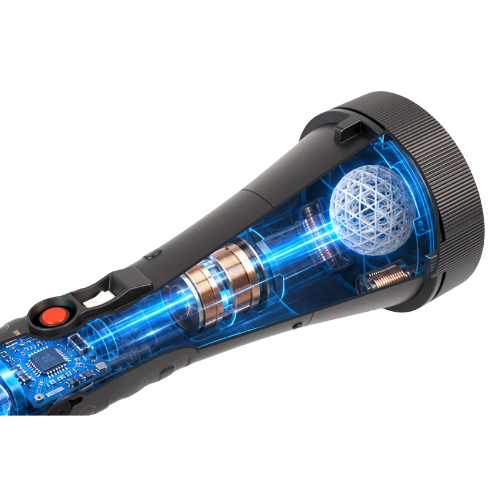
Whether you call it a net gun or a net launcher, the device reaches the target one of three ways: gunpowder, compressed gas, or electromagnetism. ZANX builds its series on a proprietary electromagnetic launch system — energized coils create a magnetic field that accelerates the net's four pull heads, with no explosion and no contact impact. That single engineering decision shapes everything that follows: where the device can be used, how quiet it is, and how repeatable every shot stays.
1. Consistent Energy, From Shot 1 to Shot 1,000
Closed-loop energy management keeps muzzle energy uniform across the launcher's 1,000-launch design life. Capacitor voltage is sampled in real time, coil timing is compensated at millisecond level, and temperature-adaptive algorithms offset voltage sag and heat build-up — so a launch on a freezing morning carries the same energy as one fired in summer heat. Powder and gas systems decay as pressure drops and charges vary: sometimes strong, sometimes weak.
2. Zero Recoil, Stable Aim
All launch energy is transferred through the magnetic field, so no reaction force kicks back into the operator's hands. Aim stays on target, single-hand operation remains stable, and on the dual-shot model the second net lands where the first one was aimed.
3. Quiet Enough for Sensitive Sites
A gas-driven launcher fires with a high-frequency detonation bang. Electromagnetic launch measures only 65–75 dB — about the level of a loud conversation. No panic in crowds, no startling patients or students, no tripping alarm systems. That is why ZANX launchers operate where traditional equipment is restricted: hospitals, schools, kindergartens, correctional facilities and fuel depots.
4. No Flame, No Odor, No Residue
Fully electric drive means no combustion and no gas reaction — nothing that can ignite in a fuel depot or chemical plant, nothing that lingers in a closed ward, and no chemical residue to clean from the scene afterward.
5. No Propellant Logistics
No compressed-gas cylinders to refill or re-certify, no chemical propellant with a shelf life. Store the device at room temperature (around 25°C) with zero leakage or deterioration risk, and a standard 12.6 V / 2500 mAh lithium battery delivers 50 or more launches per charge.
6. All Weather, All Altitude
Air pressure and sudden temperature swings do not touch the launch system: stable operation from -20°C to 60°C (single-shot model), with identical performance on plateaus and at sea level — precisely the conditions where gas-driven devices lose output pressure and power.
Electromagnetic vs. Powder & Gas — At a Glance
| Characteristic | ZANX Electromagnetic Launch | Powder / Gas Driven |
|---|---|---|
| Noise | 65–75 dB, conversation level | High-frequency detonation bang |
| Recoil | None | Perceptible kick to the operator |
| Flame & odor | None | Combustion products, propellant smell |
| Consumables | Rechargeable battery, no propellant | Gas cylinders or powder charges |
| Cold & altitude | -20°C to 60°C, pressure-independent | Output drops with pressure and temperature |
| Shot-to-shot consistency | Closed-loop controlled, uniform | Varies with pressure and charge quality |
The Bottom Line
Propulsion decides where a net launcher can be deployed and how predictable every intervention is. Electromagnetic launch removes the noise, flame, propellant logistics and weather sensitivity that keep powder and gas launchers out of schools, hospitals, correctional facilities and energy sites — while delivering the same physical restraint at 5–10 meters. Explore the net launcher series: the single-shot JC-NG-03 for everyday response, and the dual-shot JC-DNG-06 firing two nets within 2 seconds at 32 m/s.